

Sacramento State to the MAC both makes more sense and is crazier than you think
Numbers can tell many different stories

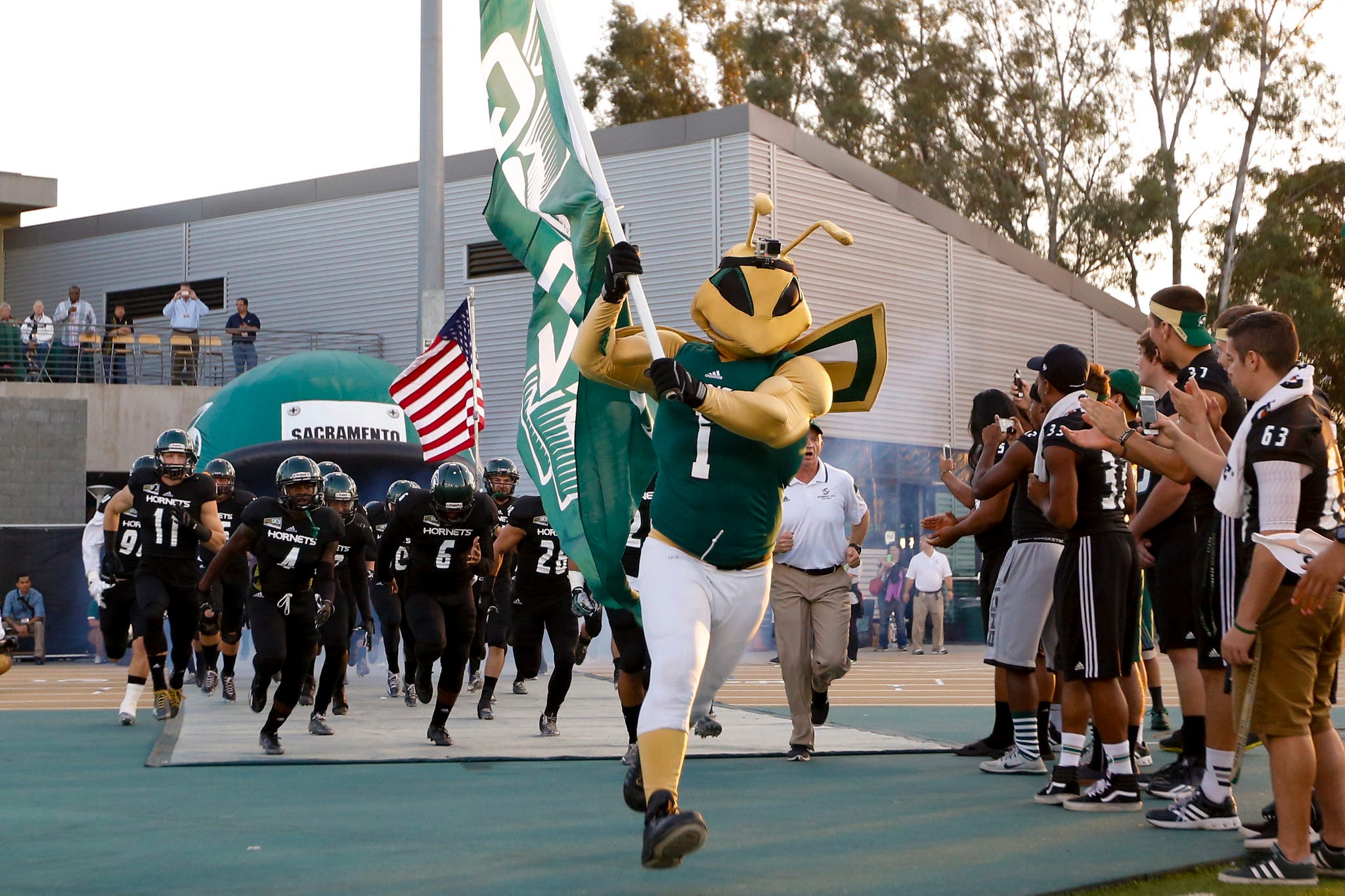
It’s not the offseason if we didn’t talk realignment, is it?
My last story was on a move that I like a lot: North Dakota State to the Mountain West. To make a long story short, I think the Bison are well-positioned to make the jump to the Mountain West and could be a huge piece in building the league’s relevancy.
But there was another realignment move that hasn’t been met with that same excitement. And one that I, as an unofficial Ambassador of MACtion, feel uniquely set to talk about.
That’s right, it’s Sacramento State joining the Mid-American Conference as a football only member. Yes, you heard right, that’s Sacramento State in Sacramento, California. Joining the Mid-American conference.
The worst part? It kind of makes sense.
More on the North Dakota State move to the FBS:

National MACtion
To start, let’s take a look at what’s going on for the Hornets in joining their new league.
Sacramento State is entering into the league starting this season as a football-only member. Their other sports will still reside in their Big West home and the gridiron Hornets will get acclimated to small, regional airports across the Midwest and Northeast.
If we put geography aside - a common refrain in the modern college football universe - Sac State fits well as a MAC school. They’re a public, state-funded school like the rest of the league. They’ll fit in right around the top of the league in enrollment, with both the University at Buffalo and Sacramento State having around 31,000 students.
It’s the financials that make up the bulk of the deal.
The Hornets will pay $18 million to the league for membership, with an additional $5 million fee going to the NCAA for FBS membership, bringing the Sacramento State final bill to $23 million. Of that $18 million due to the MAC, $6 million has to be paid up-front for membership to become official.
Sac State is also going to forgo any media distributions across the five-year pact that ties the Hornets to their new conference home. Even more, all the air travel for teams heading to Sacramento will be on the Hornets’ dime.
Let’s look at the obvious: the Mid-American Conference now stretches from Amherst, Massachusetts to Sacramento, California. That’s absolutely silly, but it isn’t new to this conference at all.
Twice in the past, the MAC welcomed far-flung teams moving up from the FCS ranks on short terms as football-only members. Most recently, the league was the first conference home for UMass as the Minutemen moved up to the FBS in 2012. All told, prior to hitting the independent ranks, UMass spent four seasons in the MAC, amassing a 8-40 record over that time frame. Yikes.
(Side note: The first FBS game I attended was a battle between Bowling Green and UMass during this timeframe. MACtion runs in my blood)
I think a more apt comparison for Sacramento State’s entry to the MAC is when the league decided to hit the Sunshine State by being the first FBS home for the University of Central Florida, better known as UCF. In 2002, the Knights joined the MAC as a football-only member. This was before the Midweek MACtion that we’ve all come to know and love, so the previously independent UCF benefited greatly from the scheduling stability that being in a conference provided. Like UMass’s first stint in the league, the Knights weren’t very successful despite a 7-5 showing in their first season, going 3-20 across their next two seasons before finding a better fit in Conference USA.
Upsides and downsides
Surprisingly, the MAC hasn’t always been focused on like-minded public Midwestern schools. UMass and UCF showed that.
Looking deeper at those moves, we see that the MAC has always prioritized media markets. UCF is based in Orlando, which ranks as a top-15 media market. Sacramento ranks as the 20th largest market, bringing more eyes on the conference. UMass stands out, as Amherst is far enough away from Boston that it doesn’t count towards that market, but it gave the conference a foothold near the 10th largest market.
Even more, the financial boosts for the conference for admitting Sacramento State is massive. The MAC is a criminally underfunded league, in part because of that midweek MACtion that we’ve all come to know and love. That deal, signed in 2014 and running through the 2026-27 season, nets the league about $8 million annually. That breaks down to just $600,000 for each of the member schools.
Sacramento State’s cash infusion into the league couldn’t come at a better time, with costs soaring due to revenue sharing and rapidly increasing coaching salaries and a media rights deal that is keeping the league at the FBS’s bottom rungs. The $6 million paid up-front to the MAC equals just over $450,000 for each of the league’s 13 members. That’s a massive payday to support those teams.
For the league, this is a no-brainer. If you want to compete on the big stage, you need cash. The MAC doesn’t have that. It’s just a fact of life at this point. Sacramento State has that and is willing to pony up that cash to make it happen. Travel costs? Doesn’t matter, the Hornets’ card will cash. Diluting the league? Possibly, but you can’t argue when you’re offered a bonus worth 75 percent of your annual salary.
It’s on Sacramento State’s side that it doesn’t make as much sense.
For one, the MAC, as much as it hurts me to say, is not a premier conference. If I’m being realistic - again, this hurts me - the league is right with Conference USA in terms of afterthoughts. SP+ pegs the bottom of the league as mid-tier FCS teams. What is Sacramento State hoping to get out of this?
More pointed, they just wanted the FBS jump to happen. Their previous Sac-12 effort to gain entry into the FBS and remade PAC-12 in Fall 2024 fell apart because the financial support was nothing more than handshake deals contingent on the school joining the PAC-12. When that didn’t immediately happen, the money never exchanged hands and the reported $35 million NIL budget evaporated into a run of the mill budget for a well-supported FCS program. Then, they applied for a waiver to compete at the FBS ranks as an independent when they left the Big Sky to the non-football Big West, which the NCAA shot down.
The move to the MAC finally fulfills that goal to get Sac State to the FBS. Hang your hat on that, Luke Wood.
It’s a well-deserved feather in the Sacramento State president’s cap, but he’s got a lot to work on in terms of the actual benefit of the move to the university. Wood posted a list of major benefits to the school on his Twitter account:
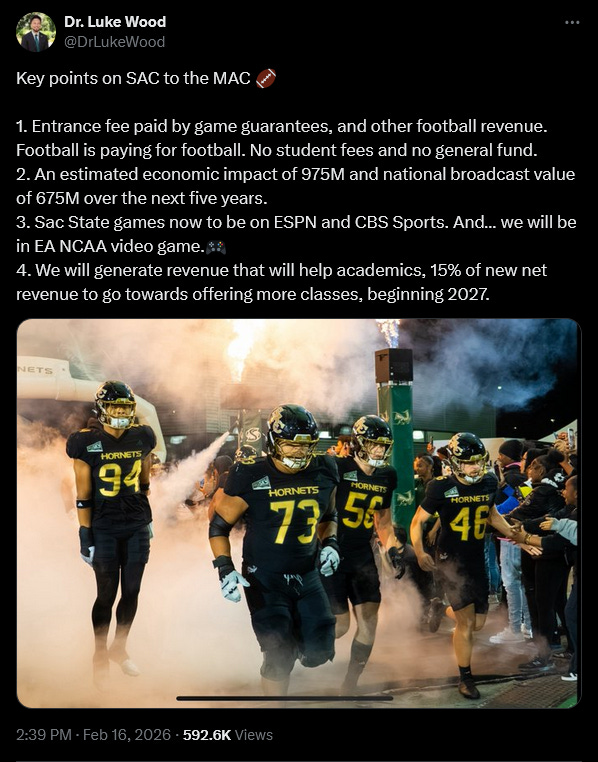
The first makes sense. These buy game guarantees are a huge piece of the MAC puzzle. Each year we see schools like Kent State, which has a particularly shoe-string budget, play multiple buy games. Friend of the newsletter Matt Brown over at Extra Points found that multiple MAC schools are earning over $3 million annually in football buy games, so the finances check out.
Getting more exposure on the national broadcasts - midweek MACtion anyone?! - and in EA’s CFB titles is a huge benefit. Especially for a president that seems like a staunch front porch believer.
For those that aren’t familiar with the Front Porch principle, it’s the idea that the athletics department serves as a front porch, or introduction, of the public to the school. I’m sure you know many of the larger schools in your area. But think of the random ones that you know about in far-flung areas of the state. I live in MACtion country and I’m talking about Sacramento State here, so it works.
With that raised awareness due to athletics, the front porch idea takes it further, with that increased awareness leading to more applications and admissions for students not in the university’s targeted area. The biggest example of this is the jump in enrollment at the University of Alabama during Nick Saban’s tenure. UCF saw an 11 percent increase in applications following the football team’s perfect 2017 season and claimed national championship.
It’s clear that’s what Wood is hoping for, that increase exposure leads to more students. But it’s the revenue piece that concerns me.
On the surface, using the additional athletics revenue to supplement academics, as Wood lays out in his fourth point, is a great idea. But relying on that revenue is where things look shaky.
For one, that $975 million of economic impact came out of left field. Remember how I said the MAC is criminally underfunded? The entirety of the conference’s media deal, from start to finish, is just $100 million. Where is this number coming from?
Fellow Substacker Richard Johnson dug deep into this at CBS Sports, talking to the CEO of the consulting firm that did the study for Sacramento State leading to those numbers. And, shockingly, he had no idea where they came from. They didn’t appear in the report, with the CEO of Collegiate Consulting telling Johnson that the $975 million overall impact amount was mischaracterized, as the data provided was not designed to be taken over the course of the five-year deal. The numbers on broadcasts were seemingly conjured out of nowhere, taking a look at what the highest valued MAC broadcasts were and basing it off of those numbers. You know, numbers that included a Toledo bowl win over Pittsburgh in 2024.
And all that ignores the fact that Sacramento State, as part of the FBS rules for moving up to the highest division, is ineligible for postseason play for its first two season, barring any waivers or massive changes.
To me, this side of things all reeks as empty promises. It’s clear that Sacramento State has the money to make it work and hold up their end of the bargain to the MAC, Brown reported that the Hornets’ budget last season would put them as a mid-tier MAC program, but past that there are serious concerns.
Is this sustainable? I don’t know. But the amounts that this move was based on for Sacramento State are just a mirage that mean nothing in the real world.
So yes, there is some sense in this wildly confusing realignment move. Sense for the MAC, at least. For Sacramento State, there’s a long and winding road ahead.
Have any questions, ideas, article pitches, or information? With the new Substack features, you can directly message me! Hit the button below to send me a message, or reach out via email to griffin@sid-sports.com, or find us on your favorite social media platform like Facebook, Instagram, Substack Notes and Bluesky.
I'm sure the Sac State players are looking forward to that Monday flight to Buffalo for a Tuesday night game in November because ESPN and the networks actually run college football.