

The Mountain West is taking big swings
How the battle for Western supremacy is shaping up


There’s a void in college football west of the Mississippi. Someone has to step up to fill that gap.
That void, of course, is that there isn’t a premier athletic conference - especially on the gridiron - since the PAC-12 nearly went belly-up in 2023. Now, we have two Group of Six leagues vying for the title and the attention of western-based college football fans.
For one, the PAC-12 is back, but only in name only. It’s a collection of the two surviving original PAC-12 members - Oregon State and Washington State - and a host of successful former Mountain West teams like Boise State. They also added Texas State because hey, someone has to be the eighth team, right?
On the other hand, the Mountain West has survived the raiding and lawsuits from the PAC-12 and is now contending for that title.
And, while the new PAC-12 has its iconic shield logo, might the Mountain West be better positioned for success long-term?
Membership
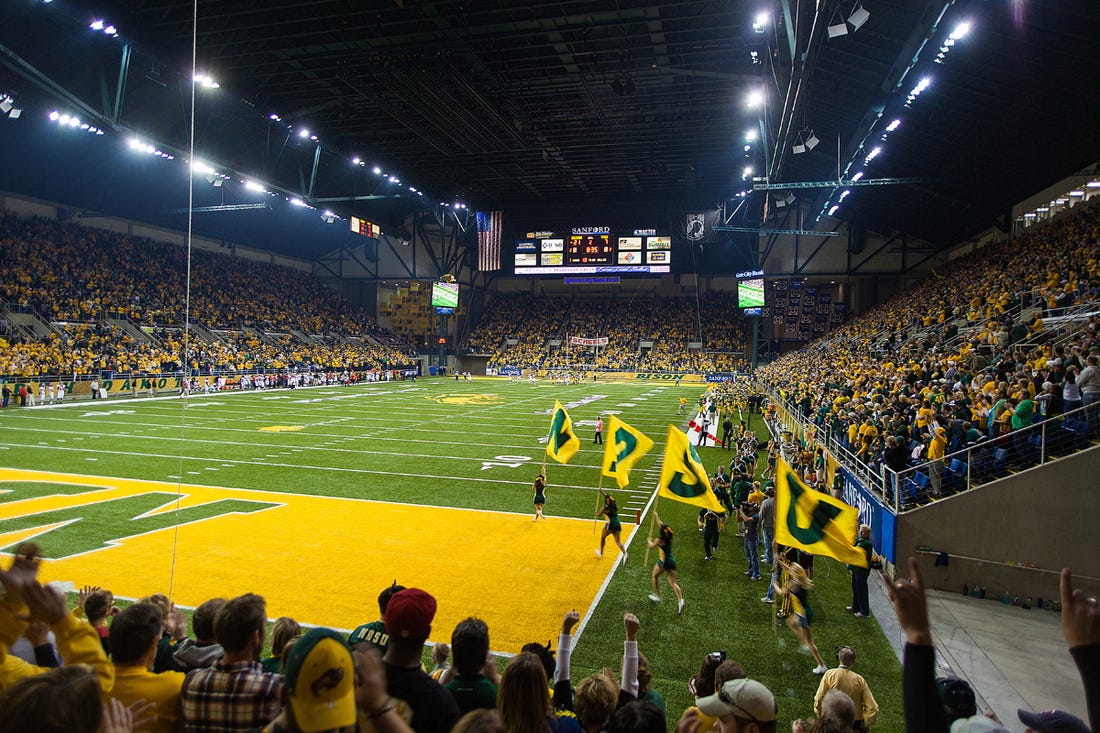
The biggest news of the weekend - well, aside from the Super Bowl and Olympic games - was that FCS superpower North Dakota State has joined the Mountain West as a football-only member, bringing the league to 10 teams total. The Bison will start competing in their new conference home this season.
One thing’s clear, North Dakota State did all it could do in the FCS ranks. The Bison have won 10 of the last 15 FCS national titles. They’re 9-5 against FBS competition since coming up to the FCS ranks in 2004. They held an FCS-record 39-game winning streak from 2017 to 2021 that shattered their old record of 33 consecutive wins, set from 2012 to 2014.
Heck, the Bison almost were ranked in the AP Top 25 as an FCS program in 2016, finishing two spots away from being the first FCS team included in those rankings.
We’ve seen success with teams moving up from the FCS ranks previously, with James Madison posting winning seasons in each of their four years of FBS competition and making the College Football Playoff last season, Kennesaw State winning the CUSA title in just their second year of FBS competition, and Missouri State earning a bowl bid their first year in the FBS ranks.
It’s not hard to envision North Dakota State reaching or exceeding James Madison’s lofty marks. The Bison ended the season ranked 65th in SP+, which would rank them as the Mountain West’s top program and 16th best Group of Six team. They ranked 45 places higher than second-place Tarleton State.
So no, this is not your typical FCS to FBS move. This is a major coup for the Mountain West. Though the Bison won’t be able to compete for a conference crown their first year due to NCAA regulations, North Dakota State will be the favorite to post the best record in conference play.
But, if we compare the Mountain West and PAC-12’s membership, who really wins?
Let’s do a side-by-side comparison of last year’s SP+ rankings based on the members this upcoming season. We’ll list the PAC-12 team first with their SP+ rank in parentheses, then the Mountain West program:
San Diego State (43) | North Dakota State (65)
Washington State (61) | Hawaii (69)
Boise State (64) | New Mexico (74)
Texas State (66) | Air Force (82)
Fresno State (67) | Wyoming (113)
Utah State (80) | Nevada (112)
Colorado State (132) | San Jose State (125)
Oregon State (134) | Northern Illinois (136)
And that’s without counting what could go down with future membership, which we’ll get into later.
Behind the scenes battles
There’s no way around it, money determines college football’s power structure. The more money you have to invest in players, staff and facilities, the better your team will be.
It’s nearly impossible for us to see what NIL budgets or revenue sharing ability would look like, so we’ll focus on the main income source for college athletics programs: media deals. The thought process is simple, whoever makes the most money has the most cash to spend. Makes sense, right?
The PAC-12 sold its incoming members on the fact that they would be able to net a top of the market Group of Six media package to position the entire league better than their previous home. They didn’t get that. Instead, the San Diego Union Tribune’s Jon Wilmer is reporting that the PAC-12 media rights deal will net around $6 million annually for each member school.
That puts the PAC-12 second in average media rights payments per school, behind the American’s $6.94 million. That didn’t seem to be according to plan, as Utah State athletic director Cameron Walker told Cache Valley Daily, “The few years in the [media deal] are a little lean. Not worse than where we were, but a little leaner than maybe we anticipated.”
And he’s right, the new PAC-12 deal brings $2 million in additional revenue over what the previous Mountain West deal provided each school. But it’s clear that the new PAC-12 and the media market viewed the league’s structure differently. The schools that ditched the Mountain West were doing so to trim the fat from the league, so to speak, and cut ties with their more budgetary constrained contemporaries.
An extra $2 million for schools of this size is nothing to sneeze at, don’t get me wrong. But a leaner media rights deal coupled with the exit payments that the departing schools have to pay the Mountain West makes this deal look a lot worse for wear.
And now, we have a direct comparison as the Mountain West has come to a deal of their own based on their new membership.
The leagues invite the comparison on their own, as both are going to go head-to-head with various games broadcast on CBS and The CW. But we’re not here for the broadcast schedules, we’re here to talk dollars.
The Mountain West deal comes in much leaner, with conference commissioner Gloria Nevarez confirming to The Athletic’s Chris Vannini that the payout for the legacy Mountain West teams will not change from their previous $3.5 million annual amount. To Nevarez, that was a big sticking point - that the conference not lose any money with their next media home.
On the surface, that’s a clear win for PAC-12 supremacy west of the Mississippi - the league has more than doubled what the Mountain West is raking in. Pair that with the guarantees that every PAC-12 football game is going to be broadcast on linear television, while only 40 Mountain West games will see linear TV, and you have a clear PAC-12 win.
Or do we?
As the title of this article reads, the Mountain West is gambling on itself. They believe there are routes to increase that media payout and find creative ways to pocket more income for the member schools.
Put it on black
No, the conference isn’t literally getting into gambling - that’s something you would see me decrying as I have other gambling-related issues on this platform.
But they are betting on themselves to punch above their weight.
The first is that the Mountain West is launching a new streaming home for all their sports, televised or not. The league’s announcement of their new deal included a tidbit about a new direct-to-consumer app launching in July ahead of the upcoming athletic season in partnership with Kiswe.
Kiswe, for those that haven’t heard, is a company specializing in hosting and delivering reliable end-to-end streaming directly to consumers. They’ve partnered with other sports teams, such as the Utah Jazz, Utah Mammoth, New Orleans Pelicans and more, in addition to other creator-driven events like YouTube duo Rhett and Link’s Good Mythical Evening events, various Smosh livestreams, and even livestreamed concerts for notable acts like Black Sabbath, KISS and Queen with Adam Lambert.
All that’s to say, Kiswe will be a clear improvement over the current Mountain West app, which doesn’t have the best reputation to say the least. But, at least it’s free for the non-televised games.
That’s going to the wayside, as the new Mountain West App, launching in July, will reportedly have two payment tiers, with both annual and monthly subscriptions available.
The app can also be bundled into an Amazon Prime subscription, making all games native to the Prime streaming ecosystem, and will be available on all forms of smart TV operating systems like Roku, the Google Play Store, Apple TV, Amazon Fire TV and more.
With the app a direct-to-consumer one, any subscriptions will be direct revenue generated for the conference and distributed amongst its members. With that being said, an app alone like this is not enough to narrow the gap between the Mountain West and PAC-12.
That, my friends, will have to come on the field.
Final frontier
Remember those SP+ rankings we looked at earlier? It’s time to get back into actual on-field competition instead of the money behind realignment moves.
When finalizing membership, the two leagues took drastically different paths to get to their eight plus teams.
The PAC-12 went for more established brands, focusing on bringing on Gonzaga as a non-football member and pursuing Group of Six stalwarts like Tulane and Memphis to round out their eight-team block. They ended up getting spurned by those schools and settled on Texas State, which has the makings of an up-and-coming school.
The Mountain West, on the other hand, prioritized geographical fits. They added UTEP as a full member and granted all-sport membership to Hawaii. Non-football members Grand Canyon University and UC-Davis bring one of the largest alumni networks in the nation and a foothold in the UC system, respectively. Northern Illinois was a add of opportunity, with the Huskies filling out the football roster and adding a new market area.
But the biggest swing was the one we looked at earlier that caused this entire article to get written - North Dakota State.
For a moment, let’s take a look at some of the more successful Group of Six schools in the past few years. Boise State earned a bye in the first 12-team playoff field, and justifiably so. The Broncos were very, very good. They’ve also been very good for most of the 2000’s, with highlights such as their Fiesta Bowl upset of Oklahoma.
Tulane came out of relatively nowhere under Willy Fritz to take a Sugar Bowl win over USC. When Fritz departed for Houston, Jon Sumrall took the Green Wave even further, earning them a spot in the college football playoff.
Finally, we have James Madison. They competed immediately upon joining the FBS ranks four seasons ago, and netted their first Sun Belt title and College Football Playoff appearance this past season.
When I think of North Dakota State, I think of James Madison. In fact, I think the Bison could be even better. Like James Madison, the program has a strong culture and environment of winning. 10 of 15 FCS national championships will do that to a program. Like James Madison, the Bison have operated like a FBS team for a not insignificant period of time and are betting on themselves to do even bigger things on the bigger stage.
I think they can do it. The Bison waited to make the move until they felt like they could compete in this new league, according to associate athletic director for development Derrick Lang in an interview with CBS Sports. They felt like they hit that in the move to the Mountain West.
Let’s take all that and boil it down into one big point for each league. The PAC-12 was chasing brands. The Mountain West was chasing potential.
That potential is what the league has to hope pans out to overtake the PAC-12. If North Dakota State competes early and follows a JMU-like path - let’s be realistic and say it takes six years for the Bison to fully break through like the Dukes last season - that could be a big boost for the league as a whole.
The CFP pays out lump sums of incentive cash to conferences based on appearances in the playoff, with $4 million for any school that earns a bid and another $4 million for schools making a quarterfinal appearance, according to Front Office Sports.
Is it unrealistic to think that North Dakota State might have a better shot to compete for that CFP cash than the PAC-12? Right now, it might be. But, if the Bison are able to raise the league up and start competing for a CFP bid, that could be a major cash infusion.
Is it a long way away? You bet. But, the Mountain West is starting to try to compete to be the top Group of Six conference. And, they may have the inside track for some other big hitters.
UC-Davis, as mentioned earlier, is an FCS powerhouse. The Aggies have made consecutive FCS Quarterfinal appearances and have earned a Top 25 ranking in 32 consecutive weeks. However, it isn’t looking like the Mountain West will sway the Aggies, as UC-Davis released a statement reaffirming their Big Sky football membership following North Dakota State’s move to the Mountain West.
The Dakota schools - South Dakota State, in particular - have traditionally always stuck together dating back to the start of the Dakota Marker rivalry when the two state schools in the Dakotas forged a relationship to move from the Division II ranks up to then-Division I-AA. They’ve played annually since then, and the allure of jumping along with their rival may come in the future. For now, there isn’t any speculation on the Jackrabbits also making the jump.
The same can be said for other FCS powerhouses, like North Dakota, South Dakota and the Montana schools. There isn’t any buzz, but if Connelly’s SP+ rankings are to be believed, they would greatly overhaul the bottom of the conference.
Right now, the PAC-12 is in a clearly better point with their media deal and higher-level membership. But the Mountain West is making a strong play. Who’s to say how it will shake out in the next five, 10, 25 years?
Either way, the Mountain West is worth monitoring.
Have any questions, ideas, article pitches, or information? With the new Substack features, you can directly message me! Hit the button below to send me a message, or reach out via email to griffin@sid-sports.com, or find us on your favorite social media platform like Facebook, Instagram, Substack Notes and Bluesky.