

Fixing College Football Part 2: The postseason
Subtle tweaks and nods to make it all better

Welcome back to Day Two of Fixing College Football! If you weren’t repulsed by my idea of taking a sledgehammer to the current college conference alignments, I’m happy to have you. If you were repulsed, please see yourself to yesterday’s comment section where I’ll happily debate you.
But conference realignment and all that is all blegh. It’s been talked about. It’s essentially one of the founding points and the death of the PAC-12 was the articles and essays that got SID Sports rolling in full. Realignment has a special place in my heart where dueling love and hate emotions duke it out to see if the impact it’s had on this newsletter can even come close to outweighing the damage it’s done to college football.
With that said, now feels like a perfect time to build on that conference realignment post, no?
If you’re new here, I’m a former Sports Information Director (SID) that’s been rambling on about pretty much anything relating to college football and college athletics as a whole. Some people have told me they’ve learned things and enjoyed the newsletter, so we always have that to hang our hats on.
Why am I telling you this? Well, mostly so you know that I at least have an understanding on how the current system works before completely and utterly demolishing it.
Speaking of sledgehammers, let’s recap that conference realignment article again:
Conferences are now regional, focusing on historical matchups and rivalries with geography in mind.
Conferences are bound to a 10-team maximum and nine conference game slate.
There are 13 conferences and eight independent schools.
Got it? Good, let’s get into the postseason and how everything is going to line up to crown our ultimate college football champion in the future. College Football Playoff Executive Committee? Your future playoff format is here, I have a very modest consulting fee.
Crowning Conference Champions
Before we get too into the weeds here, let’s preface one thing: I’m not talking dates, times or scheduling here. That’s for next week’s entry in this five-part series.
Now that we’ve got that out of the way, I want to say that I love the college football postseason. The bowl system is so incomprehensibly wacky that it’s perfectly emblematic of college football. Yes, the Playoff gives us a true champion, which I believe is what the sport was missing all along in the poll-led and BCS eras. And, expansion is correct. Everyone in the FBS deserves a seat at the table. Who cares that Luke Fickell’s Cincinnati got decimated in their lone playoff bid? They earned their spot. What would’ve happened if Scott Frost 1.0 UCF got in chasing their perfect season? Who knows! But it would’ve been fun.
Now that that’s all covered, it’s time to get into the first of our post-season changes. Conference Championships.
Meaning, no more Conference Championships. Now, this isn’t some mockery of the system like what Tony Petitti is trying to push as play-in-games for some massively expanded playoff. More like it doesn’t need to happen.
As I laid out in my conference realignment piece, we’re playing round robin style nine-game conference slates. Every year, each team will see the other teams in their conference. So, it should already be settled on the field, right? No need for a conference championship?
That plays into our schedule changes, but that’s more an issue for next week.
But Griffin, you may ask, what about if the wrong team wins? Too bad. Should’ve won on the field. If it’s the Big Ten and Indiana goes unbeaten but Ohio State is polling better, who cares? Ohio State should’ve beaten the Hoosiers and needs to stop whining.
Ties, though, can happen. And I’m not about to co-champ our way here. Instead, we’re going to tiebreaker city, everyone’s favorite part of the massive conferences. It’ll be simpler, though, than now simply because everyone’s already played each other. And, since we’re deciding conferences based on conference record, ties are likely to happen.
Tiebreakers would go as follows, in order:
Head-to-head matchup
Win percentage against next highest ranked team, proceeding through the standings
Coin toss
Yeah, I couldn’t come up with anything better than that. But still, forcing everyone to play each other each year should settle things on the field and not require so many tiebreakers like we see now.
The Playoff
With Conference Championship week dead in the water, how about turning our attention to the playoff?
Like I mentioned earlier in this article and in yesterday’s piece, expanded playoffs are better. It gives more teams a chance to win. Everyone gets a seat at the table. But we have to be careful to not expand it too far (looking at you, Big Ten).
So, we’re going with a 24-team model that mirrors the FCS playoff format. Is that larger than now in our current 12-team format that I’ve called the best way to run the playoff? You bet it is. But, in this new world, it’s a better fit.
But why expand to 24? In all honesty, it brings the FBS in line with every other major tournament. The NCAA has always said they want to have roughly 20 percent of participating schools involved in the postseason tournament. That’s how we have 68 teams in March Madness and why NCAA president Charlie Baker is looking to expand. 20 percent of the 138 FBS programs leaves us with 27.6 teams, but the 24-team bracket makes more sense with the state of the game than going up to 28.
To get our 24 teams, we’d have each of the 13 conference champions guaranteed a spot. The remaining 11 slots would be open to at-large bids, be it from any conference or Independents.
If you thought 24 teams was a departure, hold onto your butts. To seed and choose the 11 at-large teams, I’m bringing back the BCS computers. If we’re really being honest with ourselves, the computer system wasn’t the problem in the BCS era. It was the fact that only two teams got rewarded for doing well and played in a one-off championship game. Having the BCS computers wade through the mess of each college football seasons to find the best teams is much better to me than having a bunch of dudes in a room duke it out and try to see which team should get in with wildly varying criteria. We don’t have to listen to Kalen DeBoer try to convince the world that his three-loss Alabama that lost to Vanderbilt and a bad Oklahoma should get into the playoff over a two-loss SMU, with one of those losses coming in the ACC Championship game. Instead, the computers have a set formula that spits out the best teams.
We’re also going straight seeding here, so no convoluted bye process to confuse everyone and make things worse.
With that, it’s time to look at the bracket, which is an adjusted version of the FCS playoffs. The top eight seeds, which will be determined by committee votes - see, we’re not only looking at computers here! - will all earn byes. The remaining 16 teams will play in Round One at campus sites, which will be hosted by the higher seed. Round Two would include a full re-seed, with the lowest remaining seed heading to the Number One seed and so on and so forth. Round Two would also be hosted at campus sites.
The Quarterfinals and Semifinals would be played at rotating bowls, mostly the New Year’s Six - Orange Bowl, Sugar Bowl, Peach Bowl, Cotton Bowl, and Fiesta Bowl - with one additional entry: the Sun Bowl. The game has been played annually since 1935, has a great venue in El Paso, Texas and provides a great atmosphere for a major college football game. It makes sense that it fits in here.
And, to cap it all off, we’re leaning into the pageantry and tradition of college football. National Championship. January 1. The Rose Bowl. Book it.
How that works with the schedule? Come back tomorrow.
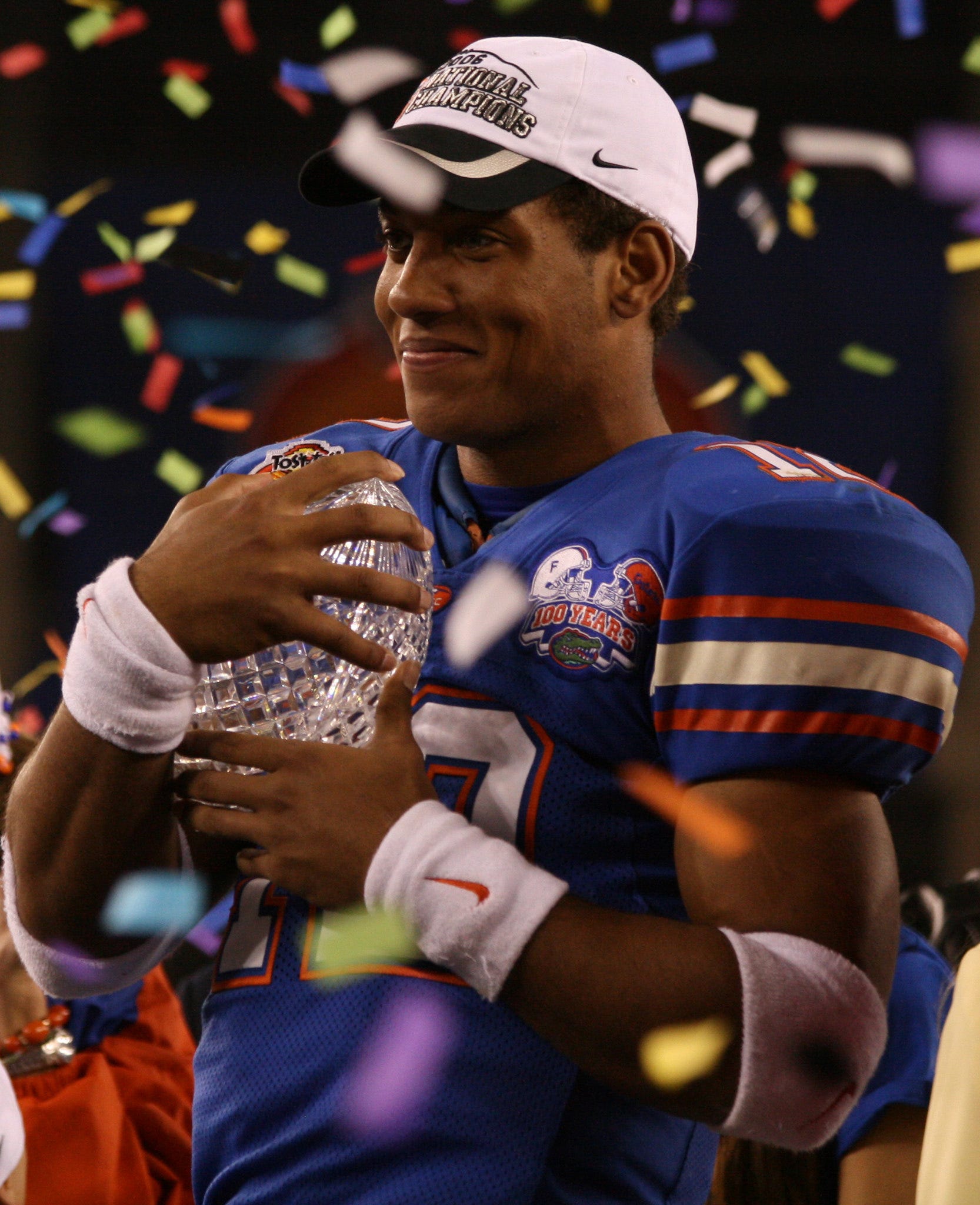
Oh, and we’re bringing back the BCS Crystal Ball trophy because look at this perfection:
Using the simulated BCS rankings from Twitter user BSCKnowHow and SP+ for teams not ranked by the BCS computers, here’s how the bracket would’ve looked with our realignment last season:
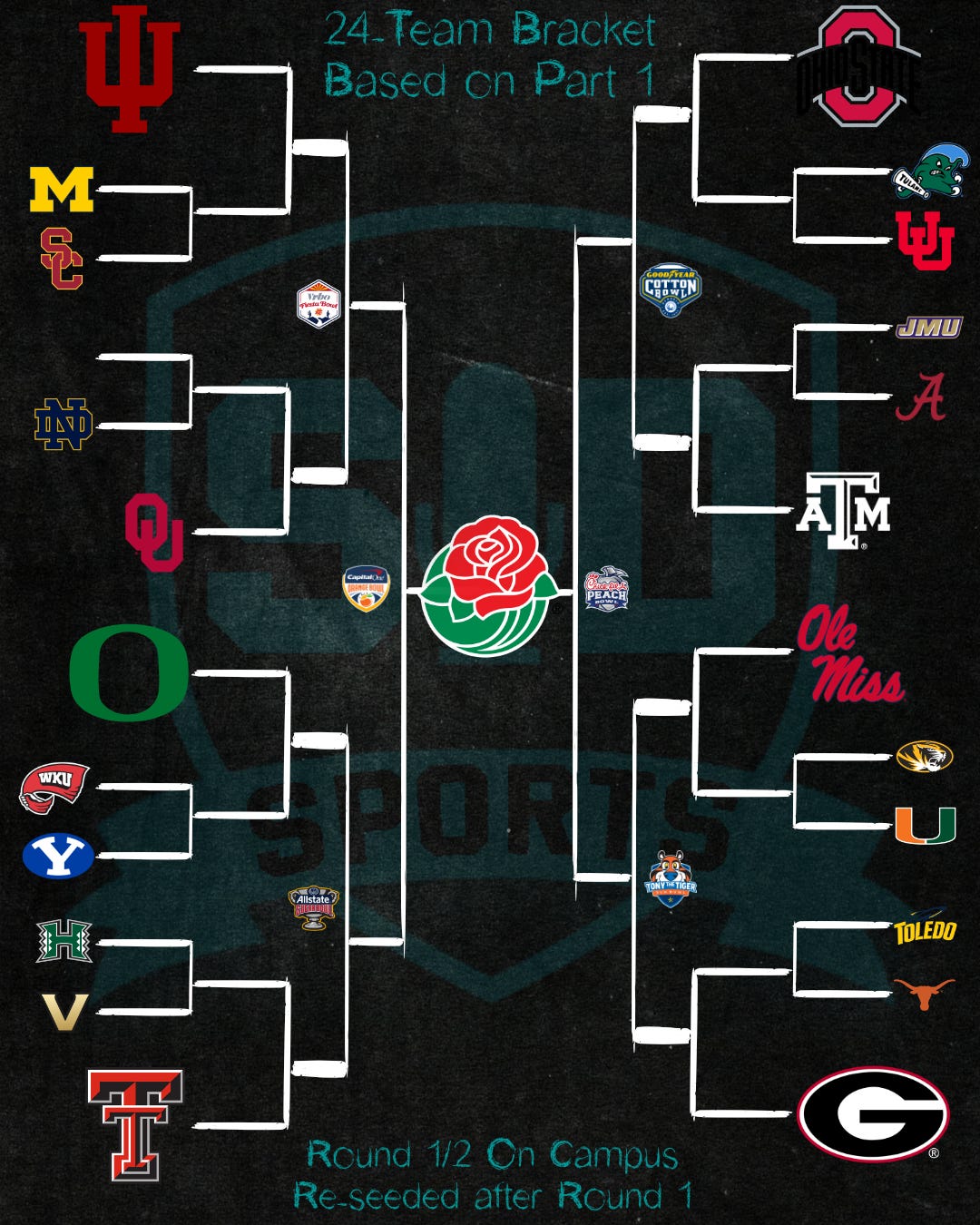
Is this perfect? No way. None of these teams played the schedule they would’ve in the new conferences (see: Part 1) or new scheduling requirements (see: Part 3). But, it gives us an approximation of what this new system would look like.
The top eight teams earned byes, and all of them likely deserved it (my disdain for the 2025 Oklahoma team remains). For the first round matchups, the bottom team will be hosting. Are there some blowouts? You bet. But those teams would’ve won their conference and played their way into the dance. They deserved it, just like the ASUN champion deserves a spot in March Madness.
Bowling For Glory
Bowl Season isn’t dead in the water, though. We’re still going to have the traditional bowls that you expect. Just, not at the time you’d expect.
Raise your hand if you’d tune in to watch the Allstate Kickoff Game without knowing who’s playing in it? What if it’s branded as the Duke’s Mayo Bowl?
That’s right, I’m stealing a suggestion from friend of the newsletter Tyler Schuster to move the bowls up in the season. Instead of having the bowls come in the postseason, with opt-outs and lacking attendance threatening to kill them, not to mention the postseason being overshadowed by the playoff itself, how about they take a new place as important once again.
That should allow matchmakers to start to build up interesting non-conference matchups that we couldn’t enshrine in the regular season. Why not have some former conference rivals duke it out for Pop Tarts glory?
To me, this means more geographical scheduling and more intent scheduling. The Bahamas Bowl is going to go by the wayside because 1) there are no college football fans in the Bahamas, 2) it’s stupid expensive for teams to go over there, and 3) who wants to coordinate getting passports for everyone?
Instead, I’m pulling on my commissioner’s cap and forcing fun into these games. The 67 Ventures Bowl? Boring. The Famous Idaho Potato Bowl? Stunning. Even better, let’s move it to the Kibbie Dome because this is America and we have fun here. GameAbove Sports Bowl? Yawn. Instead, we have the Pop Tarts Bowl.
Get the gist? We’re spurning away the boring sterilized environments and looking for fun. Give me the wacky chaos of a Pop Tart opting out of their ritualistic sacrifice to make fun of a team opting out any day of the week. Give me various foods from mayonnaise to french fries poured on coaches. Bowl games are fun. Bowl games are crazy. We need more of that in college football.
That’s not to say everything has to be a food-based sponsor. The Gasparilla Bowl does a wonderful job playing into the Tampa pirate motif that’s made even better by it being played in Raymond James Stadium. Think fun. Think getting kids interested. Think what will do well on social media.
Now, we’ve got our postseason. The new 24-team playoff and a more fun-oriented bowl season. I’ll see you tomorrow to go over what the calendar as a whole, from kickoff to recruiting, will look like in this alternate universe.
Check out the rest of the Fixing College Football Series!
Part 2 - The Postseason
Have any questions, ideas, article pitches, or information? With the new Substack features, you can directly message me! Hit the button below to send me a message, or reach out via email to griffin@sid-sports.com, or find us on your favorite social media platform like Facebook, Instagram, Substack Notes and Bluesky.
I love any idea that has college football ending on January 1st. By Jan 16 or whenever the championship game was this year, I’ve moved on.
Let's goooo. I love it!