

1ndiana: Worst to second-worst to first
The story of the greatest turnaround in modern sports history

In 1894, the Yale Bulldogs were the nation’s best team, becoming the first to win a national championship on the back of a 16-0 record. They were fresh off a tenure led by the immortal Walter Camp and, beating a collection of Ivy League schools and local athletic clubs made up of post-graduate, non-professional players, became the high water mark.
The next year, the forward pass was invented.
Four years after that, football would travel out to Bloomington, Indiana, where a local school competed as an independent for their first season, notching a 6-2 record before the turn of the 20th century. What may have been a promising start instead disintegrated as that local college, Indiana University, joined the Western Conferencce and then, ultimately, the Big Ten, where they were immediately relegated to the basement of the league. Heading into 2025, the Hoosiers racked up a record of 482-715-2, making them the losingest program in college football.
What does Indiana, a program long-marred by their inability to win on the gridiron, have to do with the 1894 Yale Bulldogs? As of Monday night, they’re the only two programs to reach the 16-0 National Champion mountaintop.
At this point, I’m sure you’ve heard a ton of stats from myself and other sources across the internet of what’s transpired in the past two seasons. But those are important, so let’s go rapid fire here.
Since head coach Curt Cignetti took over the program ahead of the 2024 season, Indiana has:
Climbed out of the all-time losses basement (Northwestern now has the most all-time losses);
Gone 27-2 in two seasons, the second-most wins in two seasons in the modern era behind the 2021-22 Georgia Bulldogs’ 29;
Earned the program’s first ever AP No. 1 and CFP No. 1 rankings;
Won their first bowl (Rose Bowl) since 1991;
Won their first ever Rose Bowl;
Recorded the only two 10+ win seasons in program history;
Doubled the program’s bowl winning totals from three to six;
Won the Big Ten for the first time since 1967;
Made their first College Football Playoff appearance;
Won their first ever Heisman trophy (quarterback Fernando Mendoza);
Won their first ever National Championship, becoming the first new champion since Florida in 1996
Have we ever seen anything like this? Definitely not in my lifetime, but I honestly can’t think of anything throughout history that equates to this.
Indiana’s Journey
We can run through the entirety of Indiana’s history, but it’s all more of the same. Just check out their all time records by season. Especially since joining the Big Ten, it’s a full list of losing seasons with a sparse winning season or bowl appearance tossed into it.
There was a glimpse of light at the end of the tunnel in the COVID-impacted 2020 season, when then-coach Tom Allen guided the Hoosiers to a 6-2 record in the shortened campaign and had Indiana ranked a then-program record 10 consecutive weeks. Allen’s work that season earned him both the national and Big Ten Coach of the Year awards.
But that light quickly faded into the void as Indiana plummeted following the departure of offensive coordinator Kalen DeBoer and quarterback Michael Penix Jr. suffering a plethora of injuries to end his 2021 early.
To me, the Tom Allen era was emblematic of Indiana as a whole. They had a great season under extraordinary circumstances that seemed like they were building on hype and the program was pointed upwards. Then it all came crashing down.
What was once filled with promise ended with three consecutive losing seasons, each one more painful than the last. Allen signed a lucrative extension following the 2020 breakthrough that left Indiana on the hook for a $20.8 million buyout that was negotiated down to a $15.5 million settlement once he was fired following the 2023 season.
By all reports, Allen was a great character guy for Indiana and loved his time in Bloomington. But results matter in this game, and Allen wasn’t getting those. After a promising start, he went 9-26 and 3-24 in conference play over his last three seasons. Indiana had cratered once again.
The Savior
The financial commitment to firing Allen was a bit shocking for an outside observer of Indiana football. I even pointed it out in October of 2023 on this newsletter, saying that “the only thing saving him: a $20 million buyout. That drops to $8 million in 2024, so it’s plausible that Indiana keeps him around for another year.”
To pat myself on the back, I did follow that up with a borderline prophetic (okay, maybe that’s a stretch) one-liner
But, with the new media deal kicking in and an uncertain future in the division-less Big 10, Indiana could decide to invest more in football. A wise first investment is $20 million to send Allen away. - Griffin Olah, SID Sports, October 18, 2023
Invest in football, Indiana did.
But their biggest move wasn’t a financial influx of cash - that would come later. No, it was to make a very Indiana hire, bringing on a Group of Five coach that has a ton of experience, but nothing at the big level. Surely those wins could translate, right?
Boy, did they. Because that coach was Curt Cignetti.
I’m not going too in-depth on Cignetti’s path to the mountaintop of college football - that’s for another day and another week’s article - but Cignetti’s hiring is where this all kicks off. And in true Indiana fashion, it wasn’t a much-ballyhooed hiring. Sure, it was noted that he was a good fit for Bloomington and Indiana, and his age was a concern, but it was noted that Cignetti had won everywhere he’d been.
Would that translate to Indiana?
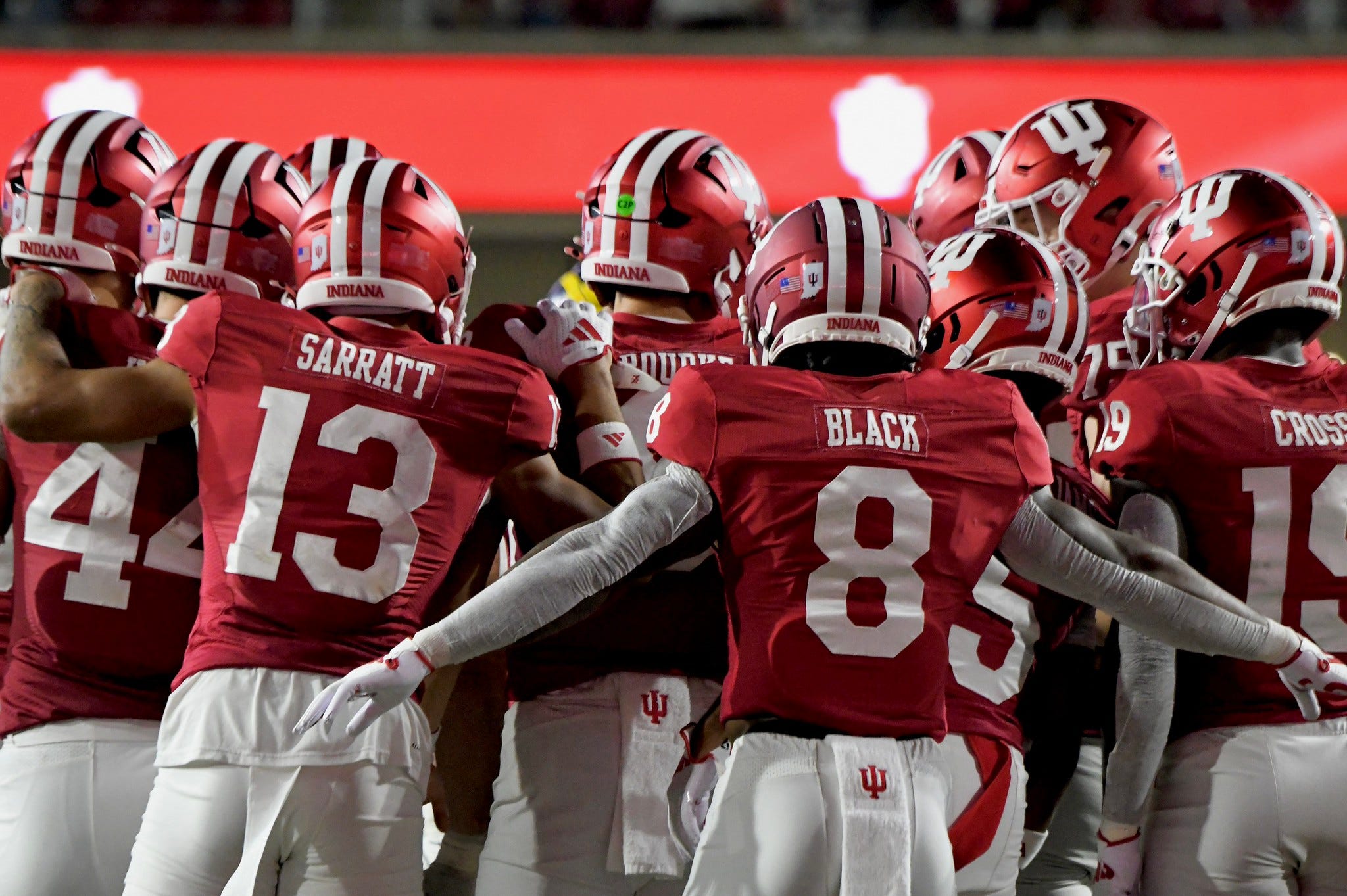
Well, bringing along his two coordinators helps. And 13 high-level players from James Madison. Guys like D’Angelo Ponds, who is now a three-time All-American. Or Mikail Kamara, who blocked the Miami punt in the National Championship. Or Kaelon Black, who had 79 yards in the National Championship. Or Aiden Fisher, the leader and lifeblood of the defense. Or Elijah Sarratt, who now has his name all over the Indiana receiving leaderboards.
In his first season at the helm, Cignetti led Indiana to what was the best season at that point in program history. On the back of a solid transfer class headlined by those JMU guys and other unheralded transfer prospects like Ohio’s Kurtis Rourke, the Hoosiers raced into national prominence. They were a justifiable entrant into the first 12-team CFP field, but weren’t competitive on a chilly day in South Bend for the state title.
But then, 2025 happened. Indiana morphed from a plucky upstart into the Death Star that Nick Saban’s retirement left vacant.
They started shoving teams into lockers, taking ranked foes behind the woodshed and beating them with a belt why repeatedly asking the “Hoosier daddy?” Just ask Illinois. Sure, there were some near misses, like at Penn State, but then Indiana wideout Omar Cooper Jr. pulled out one of college football’s most memorable catches in recent history.
Just look at the National Championship preview where I laid out how dominant the Hoosiers were during the playoff. Up until the national championship, the Hoosiers were a juggernaut. Quarterback Fernando Mendoza had more touchdowns (8) than incompletions (5) and the Hoosiers had an astounding +69 scoring margin. They’re the only team to figure out how to compete out of a bye week.
And then they did it. It was an all-timer of a game, but Indiana reached glory. They raised the College Football Playoff National Championship trophy and celebrated with everyone in Bloomington. They were the best team in college football. And it was the best turnaround in college football history.
Turning around
Yes, that last line was a bold claim, but one I’m prepared to back up. Let’s take a look at some other notable turnarounds in college football and see who can compare to what Indiana just pulled off.
2013 Auburn
Just two years prior, Cam Newton won Auburn a national championship in a 14-0 season. The next year? 3-9 and 0-8 in SEC play. The Tigers entered the season unranked and had no expectations, but went on to win eight consecutive games to close the regular season, capped off by Chris Davis’s Kick Six. Auburn made it to the National Championship, where they fell to the Jameis Winston-led Florida State Seminoles.
Verdict: Indiana. After all, the Hoosiers won the whole thing.
2003 USC
Following two consecutive non-winning seasons - 5-7 in 2000 and 6-6 in 2001 - the Trojans authored a stunning reversal of fortunes. With stars like Carson Palmer and Troy Polamalu headlining the 2002 team, USC rocketed up to 11-2. Then, the young guns like Matt Leinert and Reggie Bush took over and USC went nuclear, with back-to-back national championships in 2003 and 2004 and a 34-game winning streak.
Verdict: Indiana. While USC went higher over multiple national championships, the Trojans already had 11 titles in their halls. Indiana, on the other hand, entered the season with the most losses of any FBS program and no national championship appearances.
2017 UCF
If you want the full story here, my friend Robbie Marriage has a great write up that I’ve linked below. But, the gist of it is a story most of us have heard. UCF was 0-12 when Scott Frost took over the program. He led the Knights to 6-7 in his first season and then UCF raced to 13-0 with a Peach Bowl win over Auburn to cement their National Championship* season.

Verdict: Close, but Indiana. After all, trophies are more important that asterisks.
Okay, so maybe college football doesn’t have the Cinderella story to compare. But is Indiana the greatest turnaround in modern sports?
In all the research I did for this piece, there was only one that truly stood out to me as a competitor to what Indiana has done over the past two seasons. And it’s one that I, frankly, didn’t know much about: Leicester City.
Following a 10-year hiatus, the footy club returned to the Premier League ahead of the 2014-15 season. They were near relegation the entire season before winning seven of their final nine matches to stave off the dogs. The next year, Leicester City went on a run that is the closest comparison to Indiana in modern sports history: 23-12-3 and capturing England’s top football (soccer) championship.
So, that’s it. To even find a comparison of what just happened, you have to go across the pond to England to even find a comparison.
This is the greatest story in college football. And Indiana’s just getting started. The Hoosiers are losing most of their starters, but rank seventh in the 247Sports’s transfer portal class rankings, reloading with stars like Josh Hoover, Nick Marsh, A.J. Harris, Joe Brunner and more. Cignetti’s Death Star is now operational.
Have any questions, ideas, article pitches, or information? With the new Substack features, you can directly message me! Hit the button below to send me a message, or reach out via email to griffin@sid-sports.com, or find us on your favorite social media platform like Facebook, Instagram, Substack Notes and Bluesky.
Cig is a great story, but it’s cool to see new blood win it all — even if that comes at the expense of you know who. There’s always next year!!