


There’s a lot to be angry about in the modern college football world, but anger directed at the way the postseason is selected is a time-honored tradition dating back to the anti-computer contingent of BCS haters and moving through the anti-whatever-the-committee-is contingent of fans now.
I’m sure you’ve heard it. Heck, I’ve even said it a few times on Bluesky or in conversations with other creators here. The College Football Playoff just demonstrated that it is fundamentally broken.
How so? Depending on who you ask, you’ve got a laundry list of unforgivable offenses that have made a mockery of the sport.
Of course, I’m being hyperbolic here. It’s not really that bad. But the 12-team era has had its fair share of controversy. And this past field was likely the hardest for the committee to sort through in years, dating back to the first selection in 2014 where the conference championship-less Big 12 was tabled for a plucky third-string quarterback by the name of Cardale Jones that ran a shocking Ohio State national championship team.
So, let’s answer the age old question of is the College Football Playoff system broken beyond repair? And, if so, what can be done to fix it?
The Playoff: An objective look
The College Football Playoff was devised when the former two-team, computer-selected BCS National Championship was clearly not working. After all, there are more than two teams that have earned a chance and could compete for a national championship in a given season?
That fact was immediately proved correct by the No. 4 seeded Ohio State Buckeyes claiming the first College Football Playoff National Championship in January 2015. But the field was often marred by non-competitive games that proved that there was a divide between the truly elite - Clemson, Alabama, Ohio State, Georgia - and the others - Oklahoma, TCU, Michigan.
The playoff also pivoted from the computer-focused BCS rankings that took a composite of human polls like the Coaches’ Poll and computer matrixes like the Colley, Massey and others. After all, computers couldn’t understand a game’s context, and statistics can be misleading. Sometimes, the wrong teams were selected by the computers. The committee, it was believed, would be able to take that context along with statistics and find the best four teams. Or the most deserving four. Whatever was the flavor of the year.
You see, the committee fluctuates each year, with the 13-member committee seeing at least four new members each year. Selection committee members serve three-year terms and often are either acting athletic directors, long-time media members, or former coaches. Ahead of this season, I did a deep dive on who the committee was leading into the 2025 season.
Once the playoff got its sea legs, it was clear that four was not the right number. Conferences and fans were pushing to expand the playoff, with six and eight being the most popular numbers. Legendary coach Mike Leach even tossed out a 64-team, March Madness-like slog that is perfectly emblematic of who the coach was.
It took years, but the common refrain was clear: four teams weren’t enough. It couldn’t fully encapsulate the amount of true title contenders in each season. So, ahead of the 2024 season, the College Football Playoff was expanded to 12 teams.
And, like when the four-team field was introduced, it was immediately proven right. Both National Championship contenders - Ohio State and Notre Dame - would not have made the previous four-team field (Ohio State was ranked sixth on Selection Sunday, Notre Dame fifth).
But there were flaws. The primary one was addressed this offseason, which included the top four conference champions getting byes in the 12-team field. That meant that Arizona State (ranked 12th on Selection Sunday) and Boise State (ranked ninth) earned top-four seeds and byes. Texas, the second-ranked team on Selection Sunday, was the fifth seed. It just wasn’t properly balanced.
I think we can all agree that straight seeding has made the field feel more balanced and cohesive overall, but this year brought up all kinds of crazy scenarios that we haven’t seen in the past.
Namely, the fact that two non-power schools were included in the field. The fact that Notre Dame and Miami were flipped on Selection Sunday. The fact that Hunter Yurachek, this year’s Committee Chair, stated that Miami and Notre Dame’s head-to-head game didn’t get brought up until a barrier was removed between the two teams and they were side-by-side. The fact that Alabama didn’t drop after getting blown out in their conference championship game, while BYU was dropped from the field.
There’s definitely cracks showing. So how do we fix it?
The solution stage
Now that we’ve made it through the feelings stage, how about we find some solutions? But, before that, I just want to let you know that I have a vision for the perfect way to fix college football’s postseason so it makes sense. That vision, though, is far too overreaching to be a fix here. So, you’ll get all those changes this offseason when we’re battling for topics to discuss.
And, keep in mind, the Big Ten and SEC control all of the future CFP models, so both conferences would have to be on board with any changes we make. After all, it is a Power Two we’re really talking about here.
Expand the Field
This is the one that you’ve heard bandied around the most. Pure expansion. Heck, Kirk Herbstreit was calling for 16 teams on the official CFP Selection Sunday show!
So, what does expansion look like? To me, there are two prevailing numbers we’ll take a look at: 16 and 24.
16 is the one with the most traction, pushed by the SEC and Greg Sankey. You’ve probably seen proposals about this where the model is called the 5+11 because we love math in college football.
The model is simple, five conference champions get bids just like now, and there are 11 at-large teams. Byes are eliminated, so the top eight seeded teams host playoff games in Round One, and then subsequent rounds head to the rotating bowls.
That would alleviate the issues surrounding the byes and if they are worth more to a team than the financial windfalls of hosting a first-round playoff game. It also makes sure the schedule makes a little more sense, with all the teams playing in each round.
But it does put more power in the hands of the CFP Committee to have them select 11 at-large teams instead of the seven they struggle with now.
24 is the model championed by the Big Ten. This one, again with the math, is known as the 4-4-4-4-2-6. By the numbers, you can probably figure out how this one works. The Power Four conferences each get their top four teams in. Two Group of Six teams make the field. Then, the committee selects their top six teams that weren’t already put in. That ends up with 24 teams and a bracket that would look like this
There’d be a glut of power teams most seasons, which will certainly turn off some fans. But it would still lead to some very interesting matchups and, in a year full of parity like this, a larger field makes sense some.
Bring back the computers
If the problem was the committee, why don’t we just bypass the committee altogether?
If we’re really being honest with ourselves, were the BCS computers actually the problem? Or, was it that it only picked the top two teams to compete for national titles instead of 12 or 16 or however many.
There is an account on Bluesky, BSCKnowHow.com, that tracks what the playoff would look like if the BCS computers were in charge of picking the teams instead of the committee. That would’ve left us with this bracket:
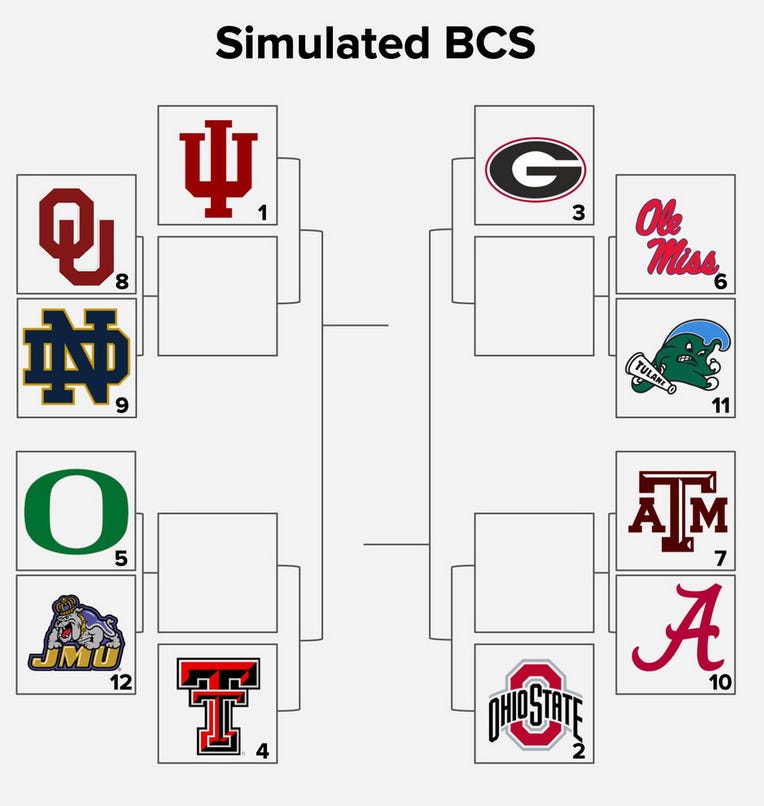
I’ll admit, there isn’t much of a difference besides Notre Dame moving up and replacing Miami, but that’s how the bracket would’ve shaken out.
For this method, the computers at least give us a formula we can follow and a way to actually view how teams’ resumes and records shake out. But, it also removes the context we talked about earlier.
Stopping the rankings shows
This is one I’ve heard getting louder recently, especially from Notre Dame’s side of things. I, for one, like having the weekly rankings releases. To me, it gives a form of transparency into what the committee is thinking about each team. Except this year, it’s clear the committee didn’t actually do their jobs.
With this, you’d have to have the committee committed to doing a full re-rank each week. Throw out what last week’s rankings were and just start at the top and work your way down. There should be no reason why a head-to-head result is ignored until two teams are right next to each other in the rankings.
But, you may say, the FCS only has three official rankings releases: one on Selection Sunday and two throughout the season with a month in between. Even more, the FCS Playoff Committee only ranks the top 10 programs publicly. Could the CFP Committee do that?
I doubt it, as the media talk around the Top 25 is what drives a lot of ESPN’s content around the rankings. And, remember, ESPN owns the exclusive media rights to the College Football Playoff, which includes five ranking shows.
That, theoretically, could be spread out more over the season, maybe with a week in between each rankings release. But, then you’d have the committee weighing in on what amounts to preseason expectations instead of what’s happening on the field.
To me, this solution just creates more headaches.
Bring back divisions!
Our final solution is the one that I personally favor, which is bringing back divisions.
Why did a 7-5 Duke get to compete for the ACC championship? Clearly, they deserved it as they beat Virginia in overtime, but would any of the other tied teams like Miami or Georgia Tech or SMU or Pittsburgh also have beaten Virginia?
To solve that, you have to fundamentally look at the way conferences are constructed. Of the tied teams in the ACC bottleneck to face Virginia, only Georgia Tech and Pittsburgh actually played. The others played wildly different conference schedules that led to tiebreakers determining who made the playoff. And, for some conferences like the American, those very same CFP Rankings we’ve complained about are selecting who plays in the conference championship. Tiebreakers are necessary, but the massive role they play in today’s game is far overreaching of where they should be.
So, let’s bring back divisions. You can’t feasibly shrink down conferences without angering every single media partner out there, so divisions it is.
The ACC has 17 teams. Split it into two divisions of nine and eight. One can be called the Atlantic Division and one the Coastal Division. Just spitballing here. But, then you guarantee those teams all play each other each year. You settle it on the field, and then the conference championship is between the two division champions.
Oh, but Griffin, the Big Ten West was bad! The Coastal division was atrocious! Won’t anyone think of that! Well, let’s bring back another friend: Leaders and Legends.
Yes, the Big Ten’s wild division plan was way ahead of its time. Now, it’s what we need. Just structure the divisions so they can be equal. We already have Rutgers travelling to UCLA on the Big Ten schedule and who can forget about the long-standing ACC rivalry between Georgia Tech and California? Geography already doesn’t make sense. So split the teams evenly.
That way, we can limit the amount of tiebreakers that determine this field.
Revamp the committee
And, our final point is to overhaul the committee as a whole.
Right now, the CFP Selection Committee has three former coaches, one former player, one retired coach/player, two sportswriters and five sitting athletic directors. And every member that has a relationship to a school has to recuse themselves from the discussion.
Remind me why there are any sitting athletic directors on the committee, let alone chairing it? Why is Hunter Yurachek bumbling his way through a coaching search almost nobody is happy with, leading this much-maligned CFP committee and trying to manage the Arkansas athletic department all at once? And how in the world is he supposed to be impartial?
Instead, let’s focus on people who are no longer in the sport, but understand football. Former coaches should make up a sizeable portion of the committee, as they can watch film, dissect if a team is good enough to make a run, and help make the best decisions surrounding the best teams overall. I don’t hate sportswriters being a part of the puzzle, but they shouldn’t have much more say than they do now. Sorry, but most of us haven’t played the sport we cover at a high level.
So, if we primarily comprise the committee of former coaches and players, with other non-active athletic folks and sportswriters sprinkled in, I think we lose some of the conflicts that the current committee structure has potential for. And, if we want to take it a step further, any working relationship with an FBS school should discount the person from being on the committee.
That’s not to say that coaches like Mark Dantonio and Mike Riley have to be recused. But if they still work in an athletic department or serve as a booster in any capacity, they can’t be in the room. I’m sorry, but I don’t trust them to be partial.
Or we could just give it to the computers. AI overlords and all that.
Have any questions, ideas, article pitches, or information? With the new Substack features, you can directly message me! Hit the button below to send me a message, or reach out via email to griffin@sid-sports.com, or find us on your favorite social media platform like Facebook, Instagram, Substack Notes and Bluesky.
Griffin, we have argued to the death about this before, but how can we take a BCS system that was two thirds humans, one third computers, and say the computers were the problem? Do we need to bring up 2008 Utah again? Best team in the country by most computer polls, but held out by the humans, because heaven forbid we let the MWC into the championship game? 2008 Florida is one of the best college football teams ever, but never got the chance to play the second best team in the country. For that, we have to blame the humans. Not the computers. This is not the purpose of the piece, so I won't drag this into a second paragraph, but I fundamentally disagree with your opinion of the BCS.
The committee is able to understand context alright. Certainly able to understand that in the context of Duke winning the ACC Championship, they had to get an ACC team in there, come hell or high water. This is what left Notre Dame out. People on the internet love to overthink this, but the ACC is clinging to the fringes of so-called 'power' status. A lack of any playoff teams would've put yet another nail into that coffin, and the committee was not interested in doing that. It really is that simple. Even though they themselves are just an ACC team that plays a few fewer conference games every year, Notre Dame never had a chance. This, in my opinion, is what they're truly angry about.
To determine an optimal playoff size, I think you have to understand what your goal is. If you mean to crown the best team champion, I think you're diametrically opposed to the history of this sport, which has never really cared about crowning the best team champion. If we mean to keep with the history of the sport, I think it's about crowning a deserving champion, which is not necessarily the best team, but the best team with either no losses or a single one possession loss who is a conference champion.
To this end, I think even four teams was too many. It just was not needed the majority of the time, but oftentimes two was too small, and a three team playoff (which most of the time feels like the optimal number) is difficult to work with, so four it must be, in my ideal 'deserving champion' world.
If we mean to crown the best team champion, first off, an end of season tournament is no way to do that, but second of all, the NFL experimented with this for years, and found the five team format (six first round byes, two play in games) worked very well to accomplish this end. Twelve really begins to rob you of the chance to see the best play the best, in the event of some upsets. Eight tends to leave out the best multiple loss teams, if we stick with five auto bids.
In all though, none of this is the real problem. The committee is the problem. Even if we take them at face value, and believe (which I don't believe) that a one possession loss back in August is what held Notre Dame out of the playoffs, how silly is that? The two teams for all intents and purposes fought to a draw that day. Who cares who won the coin flip in the end? To me, the criteria should've been everything other than the head to head game, and then come back to it only as a last resort, because this is college. We're not playing a balanced schedule like the pros. Everything else ought to be considered first, with a passing thought given to the head to head game, or possibly no thought at all, especially in this case, because it was a coin flip in August.
Everybody who knows football knows the head to head matchup means nothing, given the circumstances. How come they're acting like they don't know that? This is why I don't believe their surface-level story at all. It doesn't make any sense. It relies on a room full of people who know football not knowing anything about football, putting way too much weight on something that is weightless, or at least ought to be weightless. If it were a multiple possession game, I would be taking a different tact, but it wasn't. It was a coin flip.
In my opinion, the field needs to be set by a standardised set of criteria. If we can trust the committee to honour one, and not bend over backwards to get an ACC team in when push comes to shove, let them at it. Otherwise, we need computers, and not a one third weight on them either, like in the BCS where the computers were basically allowed to temper the humans' opinions. We need the opposite, a two thirds or greater weight on the computers, where the humans are allowed to slightly temper the computer opinion.
That concept may scare some people, but analysing by a set criteria, without room for bias to creep in, is precisely what a mathematical formula is designed to do. We can argue to the death about what the criteria ought to be, but in the end, in my ideal world, we pick a set of criteria, and we stick to it. Understanding will begin to grow as to what a playoff team actually is, and teams will begin to plan accordingly. For instance, we can put a high emphasis on the SOS component, if we want to encourage more out of conference play, or if we don't want to do that, we don't have to. We can also put a small amount of emphasis on that component. These are the arguments that would have to be had about criteria, but it's my opinion that we need to come to an agreement on a standardised set, for either the humans or the computers to work on.
Once we do that, the playoff will be fixed, because we will have a set score of playoff worthiness, and teams will understand how to become playoff worthy, because our criteria will be public. You can pick the best two, four, eight, ten, twelve teams by playoff worthiness. It doesn't matter the size. We pick the criteria, we pick the dividing line between end of season tournament worthy vs not, and we go at it.
The problem now is that teams do not understand what they must do to become playoff worthy. That was the 2017 UCF problem. That's the Florida State problem. That's the Notre Dame problem. It will continue to be a problem until we have public criteria for what exactly a playoff team is. We don't need expansion. We don't even need to restructure the committee (on the condition this one can be trusted to honour the set criteria). All we need is to say, publicly, what exactly a playoff team is, because even after 30 years of end of season tournaments, college football has never gotten around to defining what exactly being a playoff team means.
I am in the 16-team camp. I would like to see 8 conference champions and 8 at-large teams. This format might suffer the first few years, but as teams from other conferences begin to grow their fanbase, national reach, etc. it will grow the audience for college football and the playoff throughout the country. To me, there's no reason we need the fifth-best team (Oklahoma or 3-loss Bama, take your pick) from the SEC in a 12 team playoff! NIL is going to shift the dynamics in college football. It already has. Indiana! The SEC hasn't won a national championship in two years. There's a good chance it will be three after this year's CFP, even with five of the 12 teams.